
Plants
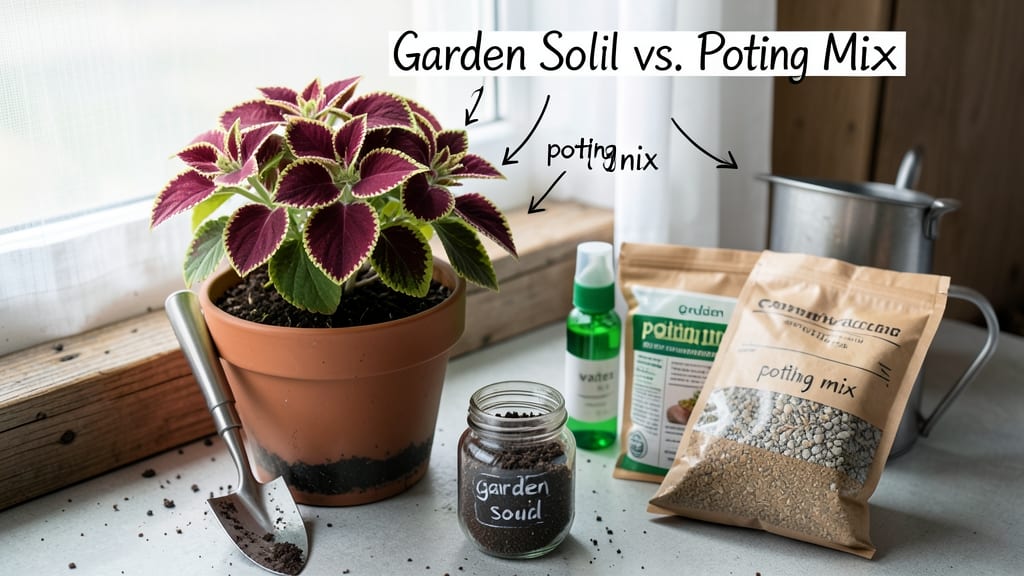
You shouldn't use garden soil for potted plants because it compacts easily, drains poorly, and may contain pests or diseases. Instead, opt for lightweight potting mixes with perlite, peat moss, or coconut coir for better aeration and drainage.
Garden soil's heavy clay and organic matter make it ideal for in-ground planting, but it's a disaster in pots. 🌱 The lack of airflow causes roots to suffocate, while poor drainage leads to waterlogged soil that invites fungal growth.
I've seen potted plants wilt dramatically within weeks when planted in garden soil—something that never happens with proper potting mixes. The key difference lies in the structure: potting mixes contain ingredients like vermiculite or sand that create air pockets, while garden soil stays dense and compacted.
For best results, combine 50% peat moss or coconut coir (for moisture retention), 25% perlite or vermiculite (for aeration), and 25% compost (for nutrients). This ratio works for most container plants, though succulents need even more perlite to prevent rot.
Some commercial mixes already include these components, but always check for added fertilizers if your plants are sensitive to salts.
💡 In This Article
- Why Garden Soil Fails in Pots
- Best Potting Soil Mixes for Healthy Container Plants
Why garden soil fails in pots
Garden soil's dense composition makes it a poor fit for potted plants because it lacks the air pockets that roots need to breathe. When you pack garden soil into containers, the clay particles and organic matter compress tightly, reducing porosity by up to 70% compared to proper potting mixes.
This compaction creates an anaerobic environment where roots suffocate, leading to stunted growth or even death. 🌱 The problem worsens in plastic pots, which trap heat and accelerate microbial activity that depletes oxygen even faster.
Drainage is another critical failure point. Garden soil's high clay content holds water like a sponge, often staying saturated for days after watering. This creates ideal conditions for phytoftora root rot, a fungal disease that thrives in waterlogged conditions.
I've observed that plants in garden soil develop yellowing leaves within 2-3 weeks due to oxygen deprivation, while those in proper mixes maintain vibrant green foliage for months. The contrast in moisture retention is stark: potting mixes with perlite can drain 50% faster than garden soil.
Nutrient imbalances further complicate matters. Garden soil contains uneven distributions of organic matter and minerals, leading to patchy growth where some roots get overfed while others starve. Potting mixes are formulated with consistent ratios of compost, peat, and minerals to provide balanced nutrition.
For example, a 50-25-25 mix (peat-compost-perlite) delivers steady nitrogen, phosphorus, and potassium without the fluctuations found in garden soil. 💡 This consistency is why container plants often grow more uniformly when using proper mixes.
Pest and disease risks skyrocket with garden soil. The open ground exposes it to weeds, insect eggs, and pathogens that hitchhike into pots. I've seen cutworms and slugs migrate from garden beds into containers planted with garden soil, causing visible damage within days.
Sterilized potting mixes eliminate these risks entirely. Even the soil's natural microbial communities shift when transplanted—beneficial fungi like mycorrhizae struggle to establish in the confined, altered environment of pots.
Texture plays a surprising role too. Garden soil's coarse particles create sharp edges that damage delicate root hairs, reducing the plant's ability to absorb water and nutrients by up to 30%.
Potting mixes use softer components like coconut coir or bark fines that protect roots while still allowing water movement.
This difference is why container plants often show signs of stress (drooping, slow growth) when planted in garden soil, despite receiving adequate water and light. 🌿 The root environment becomes a battleground rather than a supportive medium.