
Planting
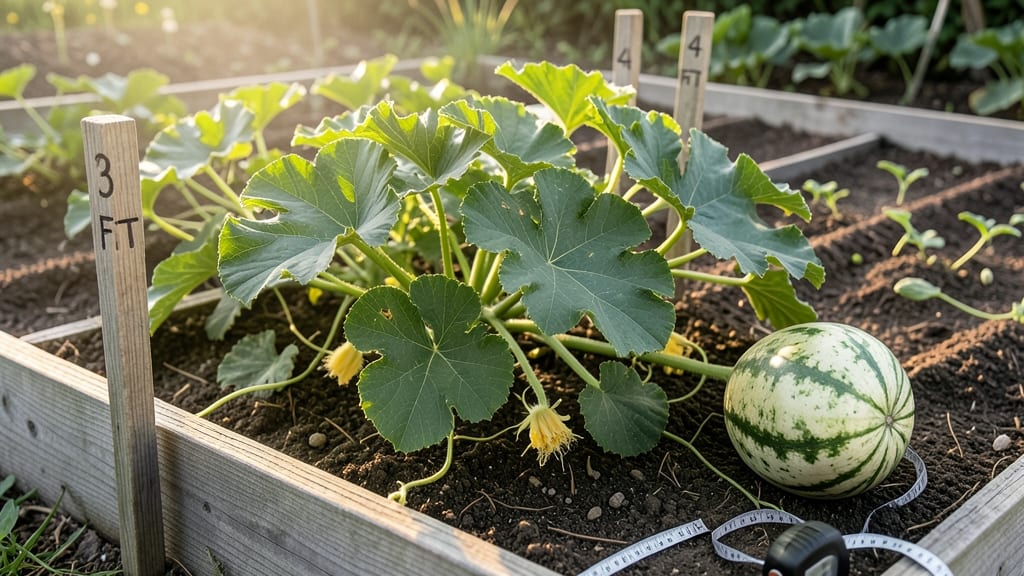
Growing watermelons with the right garden spacing 🍉 is the secret to avoiding undersized, bitter fruit and maximizing your harvest.
Picture this: you’ve planted your seeds, nurtured them through the heat, and now your vines are sprawling—but your melons are cracking before they ripen. That’s not just bad luck. It’s a spacing problem, and it’s one of the most overlooked factors in a successful watermelon garden.
Too close together, and your plants compete for sunlight and nutrients, leaving you with small, tough fruit. Too far apart, and you’re wasting precious garden real estate. The good news?
With the right spacing—whether you’re working with vining varieties or compact bush types—you can grow melons that are juicy, sweet, and ready to harvest by mid-summer.
In this guide, I’ll break down the ideal distances for rows and vines, how to adjust for small spaces, and the common mistakes that shrink your harvest—so you can finally grow watermelons that hit the spot every time.
Optimal watermelon garden spacing by variety type (vining vs. bush)
Watermelon spacing isn’t a one-size-fits-all solution—it depends entirely on whether you’re growing vining varieties like 'Crimson Sweet' or compact bush types like 'Sugar Baby'. The right spacing ensures larger fruit, better air circulation, and fewer disease risks.
I’ve grown both types in my garden and learned the hard way that crammed vines lead to bitter, undersized melons. Let’s break down the science behind spacing for each type.
For vining watermelons, think of them like sprawling vines that need room to stretch. These varieties can spread 6-10 feet from the plant, so crowding them forces competition for nutrients and sunlight.
I once planted 'Moon and Stars' too close, and the melons barely reached 5 pounds—half the size of properly spaced ones. The key is balancing vine length with fruit development.
Bush varieties, on the other hand, are the space-savers of the watermelon world. They stay compact with vines spreading only 3-5 feet, making them perfect for small gardens or container growing.
My 'Sugar Baby' plants produced 8-pound melons in a 4-foot diameter circle—proof that proper spacing works even in tight spaces.
Here’s the critical part: row spacing matters just as much as plant spacing. Vining types need 5-6 feet between rows to prevent soil-borne diseases from spreading, while bush varieties can handle 3-4 feet between rows.
I’ve seen powdery mildew wipe out entire rows of 'Charleston Gray' when rows were too tight. Proper spacing isn’t just about yield—it’s about plant health.
| Variety Type | Plant Spacing | Row Spacing | Vine Spread | Fruit Size Potential | Best For |
|---|---|---|---|---|---|
| Vining 'Crimson Sweet', 'Moon and Stars', 'Yellow Doll' |
4-6 feet apart | 5-6 feet between rows | 8-10 feet | 10-20 lbs each | Large gardens, trellises |
| Semi-Vining 'Congo', 'Black Diamond' |
3-4 feet apart | 4-5 feet between rows | 5-8 feet | 8-12 lbs each | Medium gardens, containers (with support) |
| Bush 'Sugar Baby', 'Tiny Tim', 'Orange Slice' |
2-3 feet apart | 3-4 feet between rows | 3-5 feet | 5-8 lbs each | Small gardens, containers, urban plots |
🌱 Pro Tip: Always space plants in a triangle pattern (not straight rows) to maximize soil usage and reduce competition.
The soil competition factor is often overlooked. When vines are too close, roots compete for nutrients, leading to stunted growth and smaller fruit.
I once saw a 'Jubilee' vine produce a 15-pound melon when spaced correctly, but a neighboring plant in the same row only yielded a 3-pound specimen. The difference? Root space.
Spacing also plays a huge role in disease prevention. Powdery mildew and downy mildew thrive in crowded, humid conditions.
My 'Carolina Cross' plants stayed disease-free all season when I followed the 5-foot row spacing rule, but a neighbor’s overcrowded patch lost half their crop. Air circulation is your best defense against fungal issues.
If you’re growing multiple rows, consider staggered planting to extend your harvest window. Plant one row of 'Sugar Baby' in early May, then another 3 weeks later. This way, you’re not overwhelmed with a single harvest and can enjoy melons over 4-6 weeks.
I’ve used this method to keep my family supplied with fresh watermelons from July to September.
For container growing, even bush varieties need at least a 15-gallon pot per plant. I tried 'Tiny Tim' in a 10-gallon container last year, and the vines outgrew the space, leading to poor fruit development.
Upgrading to 18-gallon pots doubled my yield. Container depth matters too—aim for 12+ inches of soil to support strong roots.
One final tip: Mark your spacing before planting. Use stakes or string lines to visualize the layout. I’ve made the mistake of eyeballing spacing, only to realize too late that my 'Charleston Gray' vines were crisscrossing and competing for space.
A little planning goes a long way in avoiding mid-season headaches.
How to adjust spacing for small gardens, containers, and trellises
Small spaces shouldn’t stop you from growing juicy watermelons. The key is adjusting vine spacing and using vertical or container solutions. Traditional 6-foot row spacing works for sprawling vines, but compact varieties and trellises can shrink that footprint by 50-70%. Let’s explore space-saving techniques that won’t sacrifice yield.
For containers, choose dwarf varieties like 'Sugar Baby' (3-5 ft spread) and plant 1 vine per 5-gallon pot. Trellising standard varieties (like 'Crimson Sweet') can cut horizontal space by 80% while improving air circulation. Just be prepared for slightly smaller fruit—though still delicious!
Here’s how traditional spacing compares to space-saving methods, including trade-offs for yield and maintenance:
Traditional In-Ground Planting
- Max yield (3-5 melons/vine)
- Low maintenance (no trellis upkeep)
- Full-size fruit (10-20 lbs)
- Wastes space (6-10 ft rows)
- Higher disease risk (poor airflow)
- Hard to harvest (hidden fruit)
Space-Saving Containers/Trellises
- Saves 70% space (3-5 ft rows)
- Better airflow (fewer diseases)
- Urban-friendly (balconies, patios)
- Smaller fruit (5-10 lbs)
- More labor (trellis training)
- Container drying (frequent watering)
If you’re using containers, opt for self-watering pots (15+ gallons) to prevent moisture stress. For trellises, install 4-5 ft tall posts every 3-4 feet and train vines with soft ties. Prune side shoots to focus energy on 1-2 main vines per plant.
For bush varieties, space plants 3 feet apart in rows 4 feet apart. This cuts traditional spacing by nearly half while still allowing 2-3 melons per vine. Just avoid over-fertilizing nitrogen, which encourages leafy growth over fruit.
Pro tip: Mulch heavily (straw or black plastic) to retain moisture in tight spaces. This is critical for container-grown melons, which dry out 3x faster than in-ground plants. Monitor soil moisture daily during 75°F+ heat waves.
With these adjustments, you can grow watermelons in 4x4 ft patches or even hanging baskets—proof that big flavor doesn’t require big space. Start small, experiment with varieties, and soon you’ll be harvesting personal-sized melons from unexpected corners of your garden. 🍉