
Planting
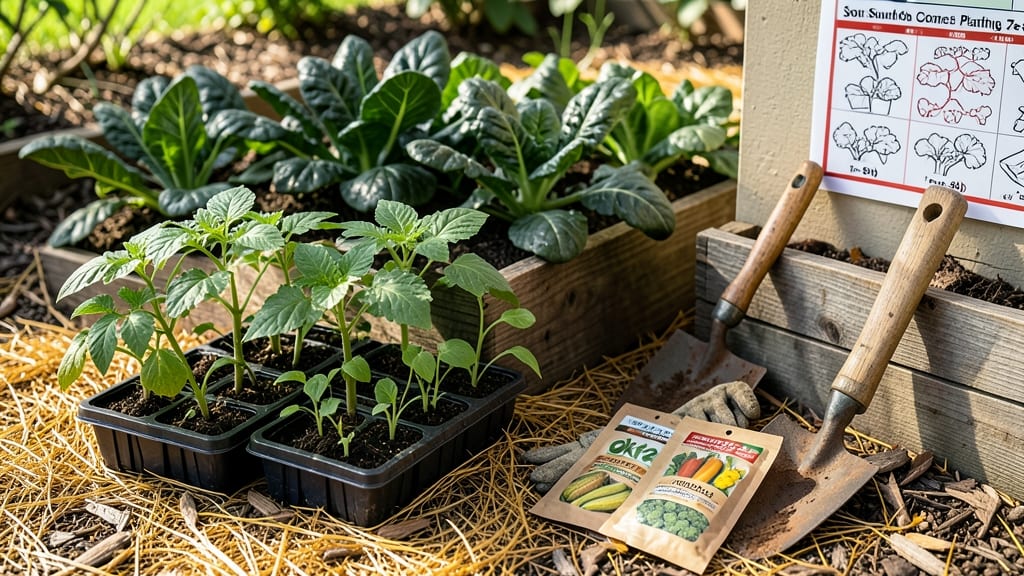
To plant a garden in South Carolina, aim for late February to early March in the Coastal Plain and mid-March to early April in the Piedmont and Upstate regions.
South Carolina’s mild winters and long growing season make it a gardener’s paradise—but timing your plantings correctly means the difference between a bountiful harvest and a wasted season. Missing the frost-free window could leave your crops struggling, while planting too early risks frost damage.
Whether you’re growing heat-loving tomatoes or cool-season greens, knowing when to start seeds indoors or transplant seedlings outdoors is key. The state’s varied climate zones mean coastal areas can start earlier than the Upstate, where frost lingers longer.
Here, I’ll break down the best planting windows by month, which crops thrive in each season, and how to adjust for your specific region—so you can grow a thriving garden all year long.
South Carolina’s frost-free dates by region: key planting windows
South Carolina’s three distinct climate zones—Coastal, Piedmont, and Upstate—create unique frost-free windows for gardeners. The Coastal Plain enjoys the longest growing season, while the Upstate mountains face earlier frosts. Understanding these frost-free dates helps you time plantings for maximum success, whether you're growing heat-loving tomatoes or cool-season greens.
In the Coastal region (Zones 8-9), the average last frost date falls between February 15 and March 15, while the first frost typically arrives in November.
The Piedmont (Zones 7-8) sees its last frost around March 15 to April 1, with first frosts in late October to November. The Upstate (Zones 6-7) has the shortest season, with last frosts around April 15 and first frosts as early as October 15.
These variations mean your planting schedule should adjust based on location. For example, cool-season crops like lettuce can go in the ground as early as February in the Coastal region, while Upstate gardeners should wait until mid-April.
Warm-season crops like peppers and eggplants need to wait until after the last frost, typically April in the Coastal region and May in the Upstate.
| Region | Last Frost Date | First Frost Date | Cool-Season Planting | Warm-Season Planting |
|---|---|---|---|---|
| Coastal (Zones 8-9) | Feb 15 - Mar 15 | Nov 1 - Nov 15 | Feb - Mar | Apr - May |
| Piedmont (Zones 7-8) | Mar 15 - Apr 1 | Oct 15 - Nov 1 | Mar - Apr | Apr - May |
| Upstate (Zones 6-7) | Apr 1 - Apr 15 | Oct 1 - Oct 15 | Apr - May | May - Jun |
For cool-season crops like broccoli, cabbage, and spinach, start seeds indoors 6-8 weeks before your last frost date. In the Coastal region, this means January sowing, while Upstate gardeners should begin in February.
Transplant seedlings outdoors once soil temperatures reach 50°F (10°C) and nighttime lows stay above 32°F (0°C).
Warm-season crops like tomatoes, peppers, and cucumbers require soil temperatures above 60°F (15°C) to thrive. In the Coastal region, plant these after April 15, while Piedmont gardeners should wait until May 1.
The Upstate has the latest planting window, with June 1 being a safer bet for heat-loving plants. Consider using black plastic mulch to warm soil faster in cooler regions.
Don’t forget about fall planting! Many cool-season crops thrive in autumn’s mild temperatures. In the Coastal region, you can direct-sow kale and carrots as late as September, while Upstate gardeners should plant by August 15 to avoid early frosts.
Succession planting every 2-3 weeks ensures a continuous harvest.
Regional microclimates can also affect frost dates. Urban areas often experience urban heat islands, delaying first frosts by 1-2 weeks. Conversely, valleys and low-lying areas tend to frost earlier. Use frost-sensitive plants like petunias as natural indicators—if they survive overnight, frost isn’t likely.
To maximize your growing season, extend it with row covers or cold frames. These tools can push spring plantings 2-4 weeks earlier and delay fall harvests by 3-6 weeks.
For example, Coastal gardeners might start tomato transplants under cover in March, while Upstate growers can harvest spinach into December with protection.
Always check local weather forecasts and historical frost data from sources like the National Weather Service or your local Cooperative Extension office
Best months to plant specific vegetables in South Carolina
South Carolina’s humid subtropical climate allows for two major planting seasons—spring and fall—with summer and winter exceptions for heat-tolerant or cold-hardy crops. Tomatoes, peppers, and greens thrive with precise timing, while herbs like basil and cilantro have narrow windows for success.
Coastal areas (Zone 8a) enjoy longer growing seasons than the Upstate (Zone 7b), so adjust your schedule accordingly.
For warm-season vegetables, start transplants in March-April (Upstate) or February-March (Coastal) after the last frost. Cool-season crops like lettuce and spinach belong in September-October for fall harvests or February-March for spring. Herbs like basil need warm soil (60°F+) to germinate, while cold-hardy kale can handle light frosts.
Direct-sowing vs. transplanting matters—peppers and eggplants benefit from 6-8 weeks of indoor starts before outdoor planting, while beans and cucumbers can be sown directly after soil warms. Upstate gardeners should wait until mid-April for warm-season crops, while Coastal gardeners can start 2-3 weeks earlier.
- 🌱 March-April: Plant tomatoes, peppers, and basil as transplants after last frost (Upstate: mid-April; Coastal: early April). Direct-sow beans, corn, and cucumbers when soil reaches 60°F+.
- 🌿 May-June: Sow okra, sweet potatoes, and southern peas for summer heat. Succession plant lettuce and radishes every 2 weeks for continuous harvests.
- 🍂 September-October: Plant broccoli, cabbage, and spinach for fall harvests. Transplant kale and collards in late summer for winter production.
- ❄️ November-February: Grow cool-season greens (arugula, Swiss chard) under row covers. Avoid planting warm-season crops—they’ll bolt or fail.
Upstate gardeners should prioritize heat-tolerant tomato varieties like 'Celebrity' or 'Solar Fire' for summer planting, as temperatures often exceed 90°F. Coastal gardeners can extend seasons with black plastic mulch to warm soil faster in spring.
For herbs like cilantro, plant in fall or early spring—it bolts in summer’s heat.
Fall planting is critical for cold-hardy crops. Start broccoli and Brussels sprouts in late August for harvests before hard frosts (typically November-December). Garlic should be planted in October-November for next summer’s harvest. Mulch heavily in winter to protect roots from freeze-thaw cycles.
Pro tip: Use SC-specific frost dates as your guide—Coastal areas average 200+ frost-free days, while the Upstate sees 180-190 days. Adjust for microclimates (e.g., urban heat islands may allow earlier warm-season plantings). Always check soil temperature with a thermometer—50°F+ for cool crops, 60°F+ for warm crops.