
Tools
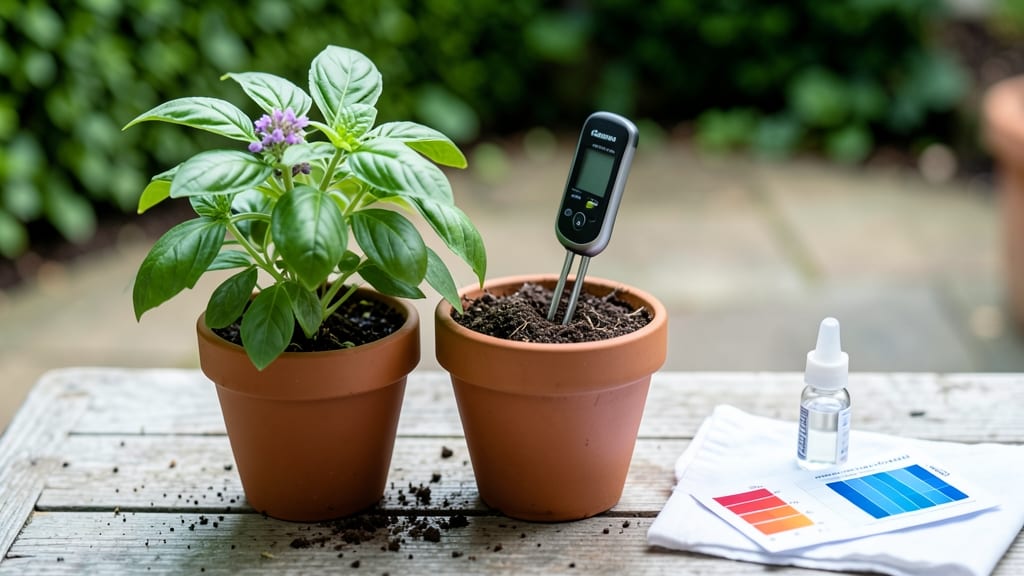
A garden pH meter helps you test soil acidity by first calibrating it with pH 4 and pH 7 solutions, then inserting the probe into moist soil for precise readings. Cleaning the probe between tests ensures accuracy for all your plants.
A garden pH meter gives you the exact soil acidity levels your plants need to thrive. 🌱 Proper calibration with buffer solutions ensures your readings are reliable, while testing moist soil prevents false readings.
I’ve found that most gardeners make the mistake of testing dry soil—this can throw off results by up to 1.5 pH points! For best accuracy, take readings from multiple spots in your garden, especially if you’re dealing with different plant types that prefer varying pH levels.
Understanding your soil’s pH is the first step to creating the perfect growing conditions.
Whether you’re growing acid-loving blueberries or alkaline-tolerant lavender, knowing your soil’s exact pH helps you adjust with amendments like lime or sulfur. 💫 The meter’s probe should be inserted about 2-3 inches deep into the soil, and always rinse it with distilled water after each use to keep it working accurately for years.
💡 In This Article
- Calibrating Your Garden pH Meter for Accurate Soil Readings
- Best Practices for Testing Soil pH with a Digital Meter
Calibrating your garden pH meter for accurate soil readings
The calibration process is where the magic happens—your meter’s accuracy depends entirely on this step. Most garden pH meters require two calibration points: a pH 4 buffer solution (representing acidic soil) and a pH 7 buffer solution (neutral). These solutions simulate the extremes your meter will encounter in real soil.
Start by filling the calibration cups with the provided liquids, then gently submerge the probe until the reading stabilizes (usually within 30-60 seconds). The meter uses these points to create a linear scale for all future readings.
Here’s what’s actually happening during calibration: the probe contains a glass electrode that reacts to hydrogen ions in the solution. At pH 4, the electrode detects a high concentration of these ions (acidic), while at pH 7, it detects a balanced state.
The meter’s internal circuitry then maps all subsequent readings between these two reference points. 🔥 For best results, use fresh buffer solutions—old solutions can degrade and introduce errors of up to 0.3 pH units, which is significant when fine-tuning soil for specific plants.
Proper calibration ensures your readings are reliable for plant health decisions. For example, blueberries thrive in pH 4.5-5.2 soil, while tomatoes prefer 6.0-6.8. A poorly calibrated meter might show your blueberry bed as pH 5.5 when it’s actually 4.8—leading you to add unnecessary lime instead of sulfur.
Most meters require recalibration every 1-2 months or after 50-100 uses, depending on the model. Always check your manual for specific intervals.
Troubleshooting calibration issues is simpler than you might think. If your meter won’t hold a reading, the probe might be dirty—clean it with distilled water and a soft brush. If readings fluctuate wildly, the buffer solutions may be contaminated or expired.
Store them in a cool, dark place to preserve their accuracy. Some advanced meters even have automatic calibration features, but manual calibration gives you more control over the process.
Understanding probe sensitivity is key to interpreting your results. High-quality probes respond to changes as small as 0.1 pH units, while cheaper models may only detect shifts of 0.5 units. This difference matters when adjusting soil for sensitive crops.
For instance, strawberries require 5.5-6.5 pH, so a meter with 0.2-unit precision will give you the confidence to make precise amendments rather than guessing.
One common mistake is skipping the calibration step entirely. Without proper calibration, your meter might show readings that are off by 1 or more pH points, leading to wasted time and money on soil amendments.
Always perform a two-point calibration before serious testing—it takes just 5-10 minutes but ensures your data is trustworthy for years of gardening.