
Tools
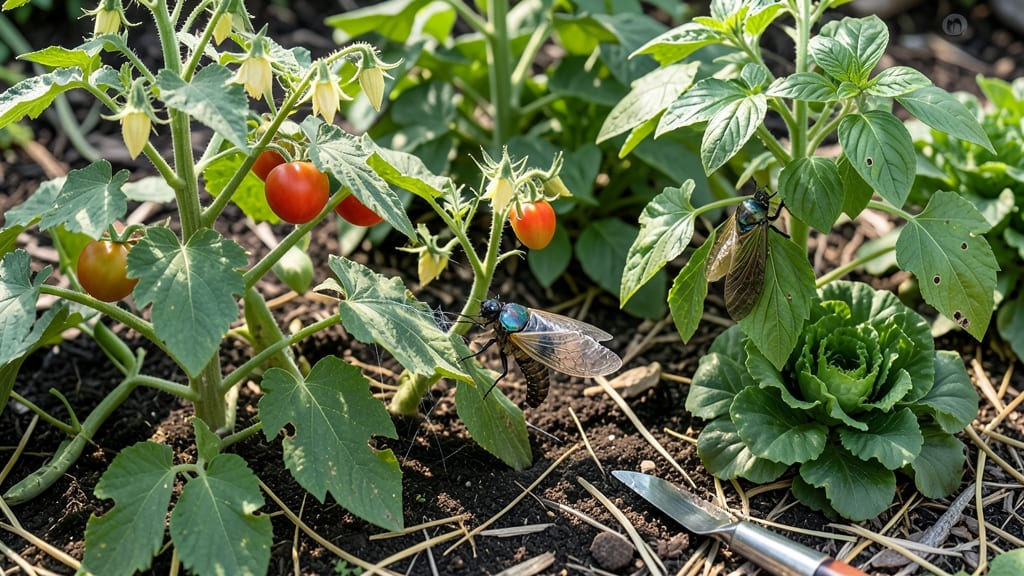
Your garden won’t be eaten by cicadas—they only consume tree sap and xylem fluids, leaving vegetables, flowers, and foliage untouched. However, their emerging nymphs can harm roots, and swarms may strip bark from vulnerable young trees or fruit-bearing plants.
Cicadas are sap-suckers, not plant-eaters—their specialized mouthparts evolved to pierce bark and access nutrients in tree xylem, not to chew leaves or fruits. 🌳 While they won’t devour your garden crops, their feeding habits can stress trees during emergence periods, particularly when swarms target weak bark like that of fruit trees or saplings.
The real concern comes from their underground nymph stage, where root damage can occur as they burrow upward.
To protect your plants, focus on shielding young trees with protective mesh wraps during peak emergence periods, and monitor for bark damage on stressed specimens. Organic repellents like neem oil can help deter swarms, while proper pruning after the season reduces plant vulnerability.
The key is understanding their lifecycle—cicadas are more of a nuisance than a threat to most garden plants.
💡 In This Article
- What Cicadas Actually Eat: Tree Sap vs. Garden Plants
- Protecting Trees and Plants from Cicada Damage
What cicadas actually eat: tree sap vs. garden plants
Cicadas have evolved specialized mouthparts called stylets that function like hypodermic needles, designed to pierce tree bark and access the xylem—the water-conducting tissue beneath the bark.
These insects don't chew leaves or fruits; instead, they inject enzymes to break down cell walls and suck up the nutrient-rich sap flowing through the tree's vascular system. 🌳 Their diet is comparable to aphids, but while aphids target tender new growth, cicadas focus on mature trees, particularly species like maples, oaks, and willows where the bark is thinner and easier to penetrate.
The reason cicadas avoid garden plants lies in their biology. Their stylets are 0.2-0.5 millimeters wide—too narrow to penetrate the thicker, waxy cuticles of vegetables or flowers, and their digestive systems are specialized for processing xylem fluids, which contain high levels of water and dissolved minerals.
For comparison, Japanese beetles (which do eat gardens) have mandibles capable of chewing through leaf tissue, while caterpillars have serrated mouthparts for leaf consumption. Cicadas lack these adaptations entirely.
However, their feeding habits can still stress trees during emergence periods. When swarms gather, their combined feeding can create hundreds of tiny wounds per square inch on bark, providing entry points for fungal infections or pests.
Young fruit trees and saplings are most vulnerable because their bark is thinner and less resilient. 🌱 For example, a single apple tree might sustain 500+ feeding sites during a peak emergence, which can weaken the tree if it's already stressed by drought or poor soil conditions.
Interestingly, cicadas don't just target any tree—they prefer species with high sap flow rates, like hickories and walnuts, which provide more nutrients. This selectivity explains why you might see cicadas swarming one tree in your yard while ignoring others.
Their feeding patterns also create visible signs: sap oozing from bark, yellowing leaves (from stress), and sometimes even honeydew deposits—a sticky byproduct that attracts ants and can coat nearby surfaces.
What most people don't realize is that cicadas play an ecological role by pruning weak branches. Their feeding stimulates trees to produce more defensive compounds, which can strengthen bark over time.
However, this benefit comes with a trade-off: the immediate stress on young or weakened trees can outweigh the long-term benefits. 🌿 For gardeners, this means protecting vulnerable plants during emergence periods while allowing mature, healthy trees to handle the feeding pressure.