
Tools
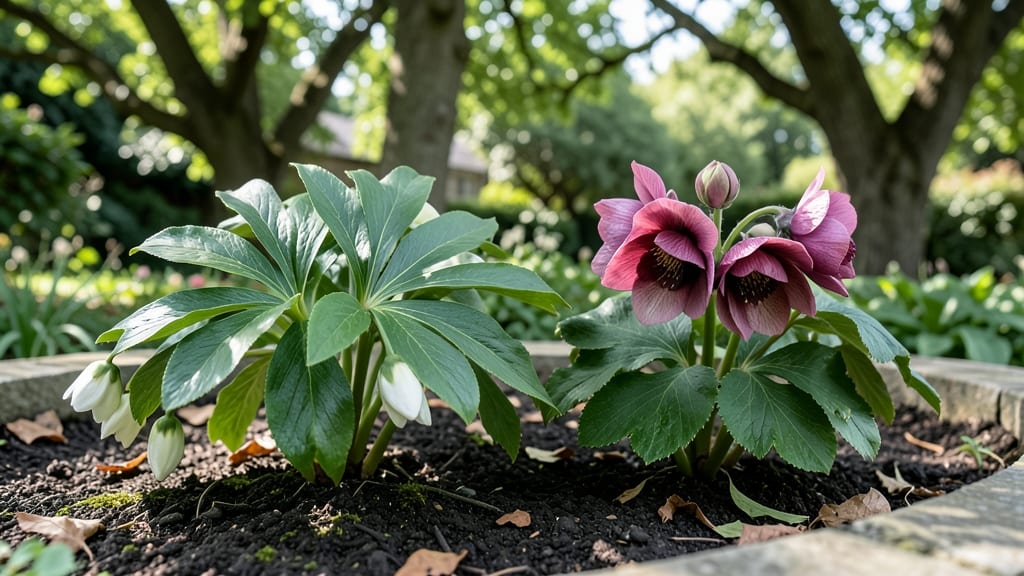
Hellebores excel in gardens as shade-tolerant perennials that deliver vibrant spring blooms, maintain lush evergreen foliage throughout the year, and demand minimal upkeep after establishment. Their resilience makes them perfect for woodland gardens and low-light areas.
These evergreen plants are nature's early bloomers, often flowering before snow melts in zones 4-9. 🌱 Their deep roots and ability to thrive in partial to full shade (even under trees) set them apart from most ornamentals.
Unlike sun-loving flowers, hellebores actually perform better with dappled light, making them ideal for problem areas like north-facing slopes or dense shrub borders where other plants struggle.
What's more, their toxic-free nature makes them pet-friendly compared to many garden favorites. I've seen them transform shady corners into pollinator magnets, with bees and butterflies drawn to their delicate flowers as soon as they appear.
The key to their success lies in their adaptability—whether you're dealing with moist soil or slightly dry conditions, they'll reward you with years of effortless beauty.
💡 In This Article
- Why Hellebores Excel in Shaded Gardens
- Planting and Caring for Hellebores Like a Pro
Why hellebores excel in shaded gardens
The secret to hellebores' shade dominance lies in their unique photosynthetic process called CAM photosynthesis (Crassulacean Acid Metabolism). Unlike most plants that open stomata during the day, hellebores absorb CO₂ at night when humidity is higher and temperatures are cooler—reducing water loss by up to 70%.
This adaptation lets them thrive where sunlight is minimal, often producing 3-5 inches of blooms in conditions that would starve sun-loving plants.
Their deep, fibrous root systems (extending 12-18 inches down) tap into moisture and nutrients other shallow-rooted plants can't access.
This explains why they flourish under trees where competition for resources is fierce. 🌿 The roots also help stabilize soil, preventing erosion on slopes—a trait that makes them invaluable in permaculture designs.
Their cold-hardiness (zones 4-9) comes from a natural antifreeze protein that protects cells down to -25°F, while still blooming when most gardens are dormant.
Hellebores' evergreen foliage plays a dual role: it continues photosynthesis year-round (even in winter) and provides a dense canopy that shades the soil, keeping roots cool and moist. This self-regulating system means they rarely suffer from heat stress or drought—unlike many shade plants that wilt when summer temperatures rise.
Their ability to flower in late winter to early spring (often 6-8 weeks before daffodils) makes them critical early-season pollinator hosts, supporting bees when few other flowers are available.
What most gardeners overlook is how hellebores' dark green leaves act as natural mulch. The broad, leathery foliage (typically 6-12 inches wide) blocks 80% of light reaching the soil, suppressing weeds while maintaining consistent moisture levels.
This "living mulch" effect eliminates the need for additional ground cover in shady beds—a feature that saves time and reduces maintenance compared to traditional mulching methods.
Consider these key botanical advantages when choosing hellebores for your garden:
- Light requirements: Perform best in partial shade (2-4 hours of morning sun), but tolerate full shade in hot climates
- Soil adaptability: Thrive in pH 6.0-7.5 and tolerate clay, sand, or loam—even poor, rocky soil
- Water needs: Drought-tolerant once established (1 inch per week in dry periods), but prefer consistent moisture when young
Their multi-season interest—spring blooms, summer foliage, and autumn seed heads—explains why they've been prized in European gardens since the 16th century. Unlike annuals that require replanting, hellebores form clumps that expand 6-12 inches yearly, creating natural ground cover without the effort of planting new specimens.