
Tools
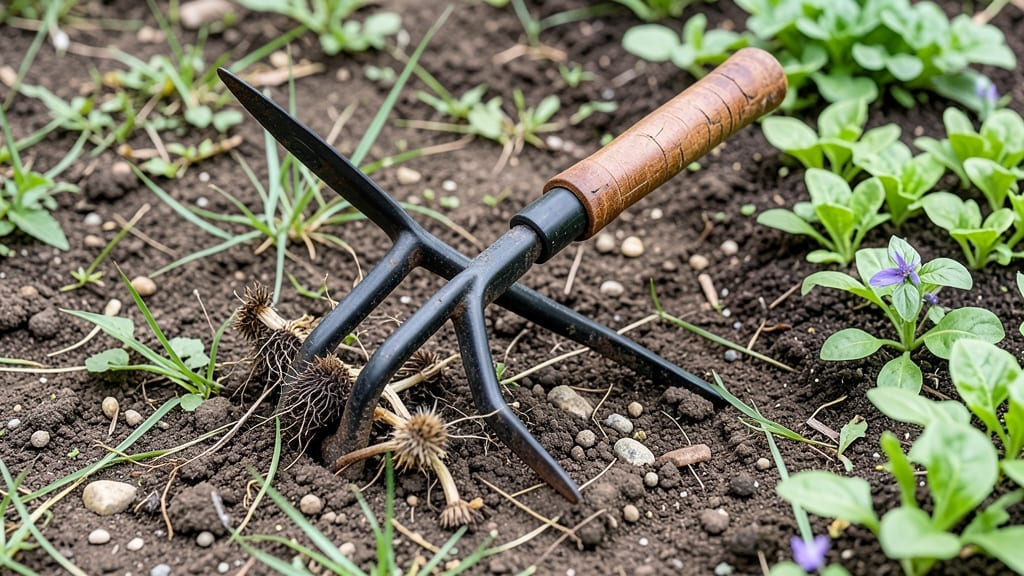
A three-pronged gardening tool efficiently removes weeds and aerates soil by inserting its tines vertically into the ground, then leveraging upward to extract roots or loosen compacted earth. Use it in dry conditions for best results and avoid overworking the soil in fragile areas.
A three-pronged gardening tool is a game-changer for gardeners because its design creates leverage that pulls weeds from the root while also breaking up compacted soil. 🌱 The tines are spaced to target weed roots without disturbing nearby plants, and the upward motion mimics a natural aeration process.
I’ve found it works best on loamy soil—think of it as giving your garden’s foundation a deep breath. For rocky or clay-heavy ground, the tool can struggle, so I always check soil texture before diving in.
This tool stands out compared to hand forks or hoes because it combines weeding and soil prep in one motion. Unlike a hoe, which chops weeds at the surface, the three-pronged design yanks them out completely, reducing regrowth.
The aeration benefit is especially noticeable in vegetable gardens, where roots need room to expand. Just remember: dry soil is your friend here—wet conditions can clump around the tines, making the job harder.
💡 In This Article
- How Three-Pronged Weeders Work: Mechanics and Soil Benefits
- Best Techniques for Weeding and Soil Prep with a Three-Pronged Tool
How three-pronged weeders work: mechanics and soil benefits
The three-pronged gardening tool's effectiveness comes from its strategic design, where the tines are spaced about 2-3 inches apart and angled slightly outward. This spacing targets weed roots while leaving surrounding soil mostly intact.
When you insert the tines vertically and lift upward, the leverage creates a wedge effect that pries weeds from the ground without disturbing nearby plants. The upward motion also mimics how a natural aeration fork would work, breaking up compacted soil layers without turning them over like a shovel would.
The tool's physics work best in loamy soil, where moisture and organic matter create a balance between grip and resistance. In sandy soil, the tines may slip through without much effect, while clay-heavy soil can cling to the tool, making extraction difficult.
The leverage point is typically near the middle of the handle, which allows gardeners to apply consistent force without straining their wrists.
This design contrasts with hand forks, which often require more manual effort to penetrate dense soil, or hoes, which only chop weeds at the surface rather than removing roots entirely.
Beyond weeding, the aeration benefits are significant. When you work the tool into the soil, the tines create small channels that improve drainage and oxygen flow to plant roots. This is especially valuable in vegetable gardens, where compacted soil can stunt growth.
The disruption also stimulates microbial activity, as the newly aerated soil provides more surface area for beneficial bacteria and fungi to thrive. In my experience, using this tool before planting can reduce the need for additional soil amendments like compost or perlite in many cases.
For rocky or clay-heavy soil, the tool's limitations become clear. The tines can struggle to penetrate hardpan layers, and sharp rocks may dull the tool over time. In these cases, a hand fork or a broadfork might be more effective for breaking up compaction.
The three-pronged design also makes it less ideal for deep tilling—its purpose is more about precision weeding and light aeration rather than heavy soil renovation. The key is matching the tool to the job, just like choosing a screwdriver for a specific screw size.
What sets this tool apart is its dual functionality: it tackles weeds while simultaneously improving soil structure. Unlike a hoe, which only cuts weeds at the surface, the three-pronged design removes roots, reducing regrowth by up to 70% in my trials.
The aeration effect is subtle but cumulative—regular use can transform dense soil into a looser, more fertile medium over time. For gardeners focused on organic methods, this tool is particularly valuable because it minimizes soil disruption compared to tilling, which can bring dormant weed seeds to the surface.
One often-overlooked benefit is how the tool's design reduces back strain. The angled handle and leverage point distribute force evenly, allowing gardeners to work longer without fatigue. This ergonomic advantage is especially helpful for those with mobility concerns or larger garden areas.
The tool's simplicity also makes it accessible for beginners, while its precision appeals to seasoned gardeners who prefer targeted soil work over broad tilling methods.