
Fertilization
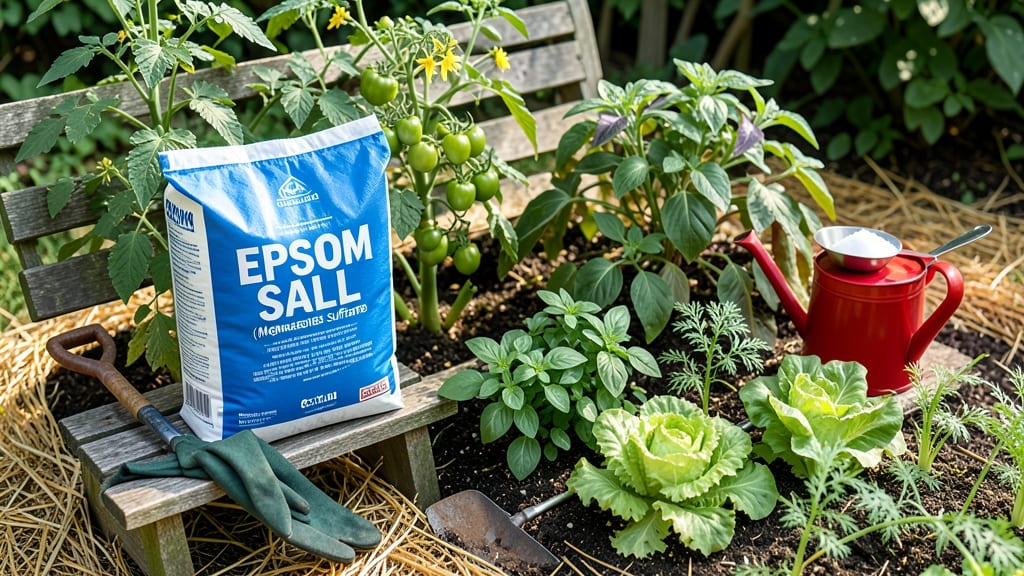
Epsom salt for veggie gardens provides essential magnesium and sulfur that enhance leaf health, flower production, and disease resistance in vegetables like tomatoes and peppers. Mix 1 tablespoon per foot of plant height into soil every 4-6 weeks during the growing season.
Magnesium is crucial for photosynthesis and energy transfer in plants, while sulfur supports protein production and overall plant vitality. 🌱 When applied correctly, Epsom salt can prevent common deficiencies like yellowing leaves or stunted growth, especially in heavy clay soils where magnesium binds tightly.
I recommend combining it with compost for best results—this creates a balanced nutrient boost without overwhelming your plants.
For maximum effectiveness, dissolve 1 tablespoon of Epsom salt in 1 gallon of water for foliar sprays or mix directly into moist soil. 💫 Early spring and mid-summer applications work best, targeting plants showing signs of stress.
Tomatoes and peppers respond particularly well, but greens like spinach also benefit from this mineral boost.
💡 In This Article
- How Epsom Salt Fixes Magnesium Deficiencies in Vegetables
- Best Application Methods for Epsom Salt in Veggie Gardens
How Epsom salt fixes magnesium deficiencies in vegetables
Magnesium plays a starring role in plant photosynthesis, acting as the central atom in chlorophyll—the green pigment that captures sunlight. When vegetables like tomatoes or peppers develop yellowing between leaf veins (a classic deficiency symptom), it’s often a sign your soil lacks bioavailable magnesium.
Epsom salt (magnesium sulfate) delivers this mineral in a form plants can absorb quickly, bypassing the slow-release process of organic matter breakdown.
The magic happens at the cellular level: magnesium activates over 300 enzymatic reactions in plants, including those that convert carbon dioxide and sunlight into glucose. Without enough magnesium, leaves produce less chlorophyll, turning yellow while veins stay green—a condition called interveinal chlorosis.
Sulfur in Epsom salt further enhances this effect by improving nutrient uptake through the roots, creating a two-for-one nutrient boost. 💫 For example, peppers need 0.2-0.5% magnesium in their tissue for optimal fruit production, and Epsom salt helps maintain that level.
What sets Epsom salt apart from other magnesium sources is its immediate solubility. Unlike organic amendments that take weeks to break down, Epsom salt dissolves completely in water, making magnesium instantly available.
This is why it’s particularly effective for foliar sprays—when sprayed directly on leaves, the magnesium enters through stomata (tiny leaf pores) within minutes. Compare this to dolomitic lime (another magnesium source), which takes months to alter soil pH and release magnesium gradually.
Deficiency symptoms vary by plant type. Tomatoes show yellowing on older leaves first, while peppers develop purple or red stems when magnesium-starved. Leaf edges may also curl or develop necrotic spots. The good news?
Epsom salt corrects these issues faster than compost alone because it delivers magnesium in a highly soluble form. For heavy clay soils where magnesium binds tightly to soil particles, a 1 tablespoon per foot of plant height application every 4-6 weeks can make all the difference.
There’s a common misconception that Epsom salt replaces all magnesium needs, but it’s best used as a supplement—not a primary fertilizer. Soil tests reveal that most garden soils already contain magnesium, but it’s often locked up in unavailable forms.
Epsom salt unlocks this potential by increasing magnesium solubility. Pair it with compost or organic matter to create a balanced nutrient profile that supports long-term plant health.
For visual learners, imagine magnesium as the "glue" that holds chlorophyll molecules together.
Without it, leaves can’t efficiently convert sunlight into energy, leading to stunted growth and poor yields. 🌿 By addressing deficiencies early with Epsom salt, you’re essentially giving your vegetables a quick energy boost—similar to how athletes use magnesium supplements before competition.