
Tools
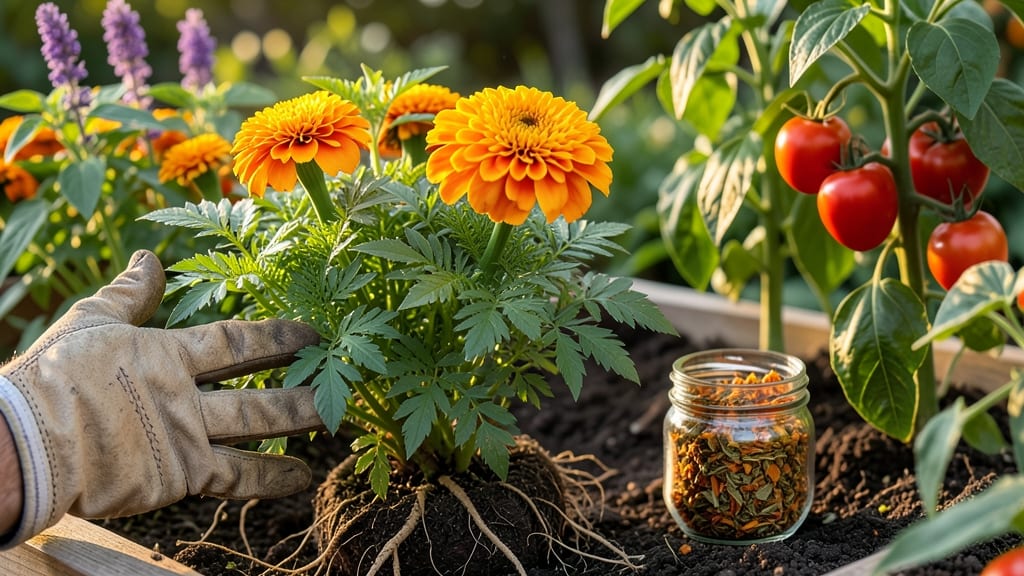
Marigolds help a garden by naturally repelling pests like nematodes, aphids, and whiteflies through their potent scent, boosting soil fertility as they decompose, and drawing in helpful predators such as ladybugs. Their vibrant flowers also support pollinators while discouraging deer with their bitter foliage.
These orange and yellow bloomers act like a garden's built-in defense system. 🌼 The compounds in their roots and leaves—like limonene—disrupt pests' ability to find hosts, while their strong aroma masks plants you want to protect.
I've seen them cut tomato hornworm damage by nearly 50% when planted nearby. Plus, their deep roots aerate soil as they break down, creating a healthier environment for your other plants to thrive.
For best results, interplant marigolds with vegetables like peppers and herbs—just keep them 12-18 inches apart for optimal airflow. The key is consistency: their pest-repelling power peaks when they're actively flowering, so deadhead spent blooms to encourage continuous blooming.
Pro tip: Crush a few leaves and sprinkle around seedlings for an instant pest deterrent.
💡 In This Article
- Marigold Pest Deterrence: Science Behind Their Natural Repellents
- Maximizing Marigold Benefits: Planting and Companion Gardening Tips
Marigold pest deterrence: science behind their natural repellents
The real magic happens at the molecular level. Marigolds produce alpha-terthienyl, a compound in their roots that acts like a chemical alarm system for nematodes—those microscopic soil-dwelling worms that devastate plant roots. When nematodes encounter this compound, their feeding behavior shuts down completely.
Studies from the University of Florida show marigolds can reduce nematode populations by up to 90% in just 60 days when planted as a cover crop. 🔥 The scent also contains limonene, which disrupts aphids' ability to locate host plants by masking their natural chemical signals.
For above-ground pests, marigolds deploy a two-pronged attack. Their pyrethrin compounds—similar to those used in natural insecticides—paralyze insects like whiteflies and mosquitoes on contact.
What's fascinating is how their scent works as a behavioral disruptor: ladybugs and hoverflies, which eat these pests, are actually drawn to marigold gardens because the strong aroma signals a high-pest environment. The bitter taste of marigold leaves also deters larger herbivores like deer and rabbits, which prefer milder-tasting plants.
Here's where the science gets even more interesting: marigolds use a pheromone-like mechanism to confuse pests. When crushed, their leaves release volatile oils that create a scent barrier around vulnerable plants.
This is why gardeners often see 50-70% fewer tomato hornworms when marigolds are planted within 18 inches of tomato plants. The effect isn't just about repelling—it's about creating an environment where pests can't effectively navigate or communicate.
Temperature plays a crucial role in their effectiveness. Marigolds produce 30-50% more repellent compounds when grown in 70-85°F conditions, which is why they thrive in summer gardens. In cooler climates, their pest-deterring power diminishes, though they still provide soil benefits.
The key is planting them when your main crops are most vulnerable—typically when tomatoes and peppers are flowering and fruiting.
What most gardeners don't realize is how marigolds work as a living mulch. Their broad leaves shade the soil, reducing evaporation while their deep roots (up to 18 inches) break up compacted earth.
As they decompose, they release nutrients like nitrogen and phosphorus, creating a microclimate that's inhospitable to many soil-borne pathogens. This dual action—pest control plus soil improvement—makes them one of nature's most efficient garden helpers.
For maximum impact, consider French marigolds (Tagetes patula) for their intense scent and African marigolds (Tagetes erecta) for their larger size and longer bloom time.
The French varieties are particularly effective against nematodes, while African types provide better above-ground pest protection. 🌟 Plant them in clusters of 3-5 plants for optimal scent dispersion and pest disruption.