
Pests
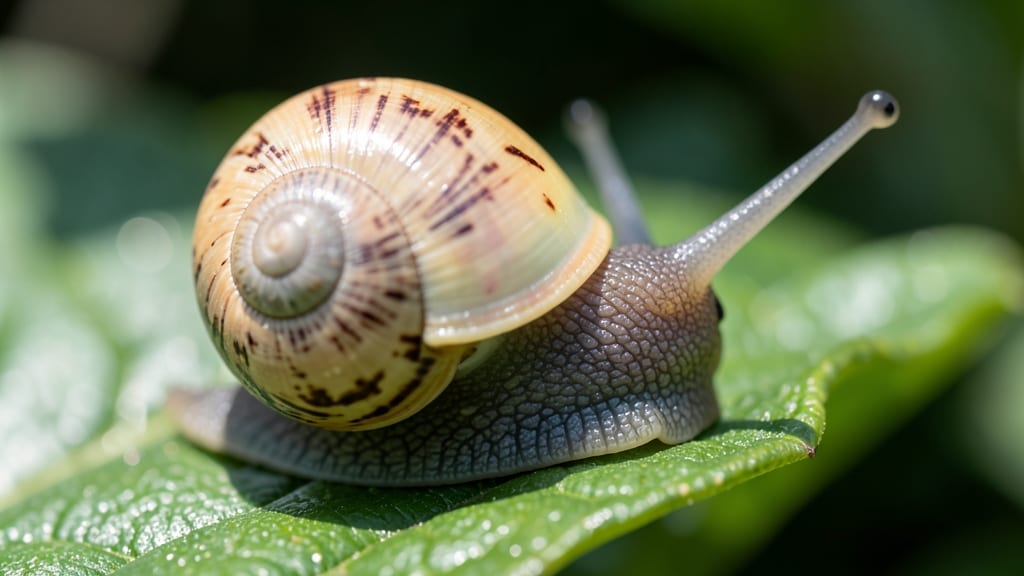
Understanding garden snail anatomy reveals their coiled shell for defense, muscular foot for movement, and retractable head equipped with sensory tentacles, eyes, and a radula for scraping food. Their unique lung cavity enables breathing on land, while mucus glands create a slippery trail that doubles as moisture retention.
The coiled shell serves as a portable fortress, allowing snails to retreat completely inside when threatened. 🐌 Their muscular foot isn't just for gliding—it functions like a vacuum, creating suction to pull their bodies forward while leaving that telltale slime trail.
That mucus isn't just for mobility; it's packed with antimicrobial properties to prevent infection and keep their delicate bodies hydrated in dry conditions.
The two sensory tentacles (longer upper pair for smelling, shorter lower pair for touching) work together to navigate gardens, detect food sources, and avoid predators with remarkable precision.
What's fascinating is how these features work in harmony. The radula, a tongue-like structure lined with tiny teeth, acts like a rasp to scrape decaying plant matter—a perfect adaptation for garden ecosystems.
Meanwhile, their lung cavity (located near the head) allows them to breathe without needing water, explaining why they thrive in damp but not submerged environments. This anatomical package makes them both resilient survivors and persistent garden pests.
💡 In This Article
- How Garden Snail Anatomy Supports Survival in Gardens
- Identifying Garden Snail Body Parts for Pest Control
How garden snail anatomy supports survival in gardens
The coiled shell of garden snails isn't just decorative—it's their primary defense mechanism. Made primarily of calcium carbonate, this spiral fortress can weigh up to 10-15% of the snail's total body weight in mature specimens.
When threatened, they retract completely inside, sealing the opening with a mucus plug that hardens within 30 seconds.
This shell also serves as a water reservoir during dry periods, with microscopic pores that regulate moisture loss. 🔥 The spiral design actually provides structural stability against crushing forces, making it harder for predators like birds to break through.
Their muscular foot, which covers about 70% of their body surface, functions like a biological vacuum cleaner. It secretes a continuous layer of mucus—up to 0.5 milliliters per hour—that reduces friction while providing antimicrobial protection.
This slime contains proteins that prevent bacterial growth and even help repair minor skin damage. The foot's wave-like contractions create suction, allowing them to climb vertical surfaces like leaves and stems with forces equivalent to 1/10th their body weight per square millimeter of foot contact.
The radula, a ribbon-like structure with 100,000-200,000 microscopic teeth, is their secret weapon for feeding. These teeth, made of chitin and iron, can scrape through plant cell walls with pressures exceeding 100 grams per square millimeter.
The radula's constant movement (up to 100 strokes per minute) creates a sandpaper effect that turns leaves into a fine pulp. This specialized feeding apparatus explains why they prefer soft, decaying vegetation—it's the most energy-efficient way to extract nutrients from garden plants. 🌱
Their sensory system is equally impressive. The two upper tentacles contain 10,000 chemoreceptors that detect food sources from up to 3 meters away, while the shorter lower pair has 2,000 mechanoreceptors for texture detection. This dual system allows them to locate rotting fruits or damaged leaves with near-perfect accuracy.
Their eyes, located at the base of the upper tentacles, can detect movement but have poor resolution—relying instead on chemical cues for navigation. This sensory adaptation explains why they're drawn to fermenting organic matter, which releases volatile compounds they can detect through their tentacles.
The lung cavity, located near the head, is their respiratory innovation. Unlike aquatic snails, garden snails have evolved a single lung-like structure that can extract oxygen from air. This cavity has a surface area of about 20 square millimeters in adult snails, with internal folds that maximize oxygen absorption.
They can survive up to 3 days without water by slowing their metabolism and retracting into their shells, but they must keep their lung cavity moist to prevent damage. This adaptation explains why they're most active during high humidity periods—their bodies lose moisture rapidly in dry conditions.
What makes these adaptations truly remarkable is how they work together in garden ecosystems. The mucus trail isn't just for movement—it creates a chemical trail that other snails can follow, explaining why they often travel in groups.
Their shell's calcium content also makes them vulnerable to acidic soils, which is why they prefer neutral to slightly alkaline garden beds. Understanding these biological quirks reveals why traditional pest control methods often fail—targeting just one feature (like the slime trail) rarely disrupts their entire survival strategy. 💫